Posts

Alexander Nevsky (1938)

Image
Sergei Eisenstein's "Alexander Nevsky" In 1938, the Soviet Union had a very strained relationship with Germany. Germany was ramping up its war preparation efforts and the Soviets had to be ready. Sergei Eisenstein, almost 10 years after making his last picture, was given a choice of several historical subjects to film by Soviet film tsar Boris Shumyatsky. Eisenstein chose the mostly unknown 13th century story of the Russian victory over German knights of the Teutonic order, led by warrior prince Alexander Nevsky. This historical event would serve as the first sound film that Eisenstein ever made. It's subject would also prove important. The victory over German invaders would become an important story to tell at a time when war was impending and the Russian country would need to come together to stand against those who would inevitably invade.  The film opens with a reminder that Russia has been at war plenty of times. The most recent of these wars in the film was the ...

Old and New (1929)

Image
Sergei Eisenstein’s Old and New Eisenstein’s Old and New shift away from his films about a collective mass of people making decision. Rather, it focuses on a peasant woman named Marfa who transforms the individualistic rural farmers into a collective communal farm community. At the beginning of the film, Marfa recognizes that the individual privatization of farmland is not working, as all the farmers and peasants are starving and cannot grow crops or bring up cattle. After facing a lot of resistance from the rural agrarian community, they are able to pull together to buy machine that converts milk into butter. Then, with the money they use to sell butter, they are able to buy a bull so that they can breed and raise more cattle. Soon they are able to purchase a tractor to more effectively gather crops. Eventually, this cooperative becomes and effective form of agriculture with the number of members growing.  However, there are those throughout the community that resist these changin...

October (Ten Days That Shook the World) (1927)

Image
Sergei Eisenstein’s “October (Ten Days That Shook the World)” In 1927, Sergei Eisenstein released October (Ten Days That Shook the World) in honor of the 10th anniversary of the 1917 October Revolution. The film depicts the events of the revolution from the perspective of the victorious Bolsheviks. With this film, Eisenstein is able to further develop his theories of montage while also trying to place the historical events of the birth of the Soviet Union on a pedestal. The success of October did not live up to the success of Eisenstein’s previous film, Battleship Potemkin. Many people criticized the film for being stilted and artificial, especially since the events were still in recent memory. Eisenstein focused more on ‘intellectual montage’ with this film, which does not strike as much of an emotional chord as the other forms of montage. Because of this more intellectual aspect of the film, many felt it was too formal – especially since the subject matter is a very emotional experie...

Battleship Potemkin (1925)

Image
Sergei Eisenstein’s Battleship Potemkin In 1925, Sergei Eisenstein brought his theories of film montage to effect in his first feature length film, Strike. Later that year, he created what many consider to be one of the most important films ever made, Battleship Potemkin. The reason Battleship Potemkin is so widely considered important is due to the Odessa Steps sequence, in which Odessa citizens are brutally shot at by the state forces. The sequence is most notable for its harrowing depiction of violence as well as the montage theories Eisenstein enacted. The film takes place on the twentieth anniversary of the actual mutiny of the Battleship Potemkin vessel, a point in history that many consider the first step towards the Russian Revolution of 1917. It was created by Eisenstein and the political Communist party of the Soviet Union to create in the viewer an emotional response, in the hopes to keep citizens on the side of the party.  The film itself is a simple story. In the first...

Strike (1925)

Image
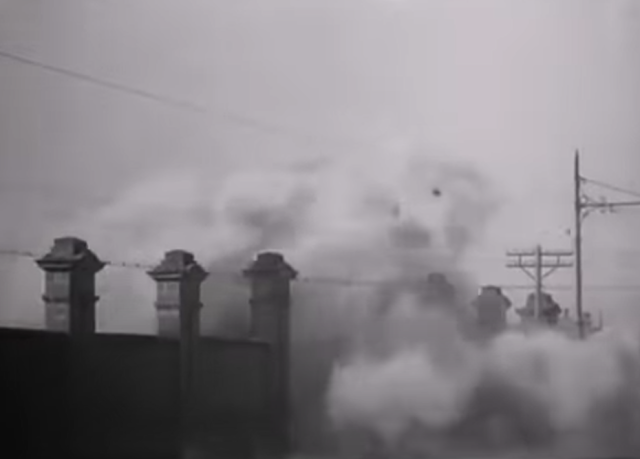
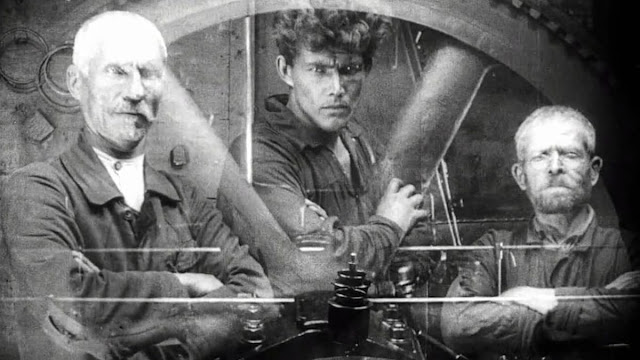
 Sergei Eisenstein's "Strike" Sergei Eisenstein's 'Strike' takes place in 1903, at a time when class division was high in Russia. The Industrial Revolution had taken hold of the country. For the world, the Industrial Revolution brought the mass production of materials and technology. With this, capitalism really started to take hold as owners of capital and other means of production became richer and were able to exert more control over their workers. The industrial capitalists and nobles of Russia began to seize power over the working class. With the spread of capitalism, the notion of individualism also spread inherently. The infiltration of Western ideals into the Russian culture created the early 20th century tensions that would eventually lead to the Soviet Revolution of 1917.  This gave rise to Vladimir Lenin, who led the working class proletariat to overthrow the industrial capitalists and the aristocracy that propped it up.  It is with these ideas the ...

The Cameraman (1928)

Buster Keaton & Edward Sedgwick's "The Cameraman" Buster Keaton's "The Cameraman" follows a similar pattern to the rest of his work. A man is completely inept at what he is trying to accomplish. He needs to complete what he is trying to accomplish in order to get the girl he is after to be with him. However, the point of the film, much like the point of all of his work, is that the man keeps trying - even though he is inept. At one point in the film, he brings MGM film of a street brawl, only to realize that there was no film in the camera. Dejected, he leaves. The girl tells him to keep trying - the only way is forward. This message speaks to Keaton's work as a whole. Regardless of the character he is playing, his characters keep trying, even through making mistakes. In the end, Keaton is able to accomplish the task and get the girl.  

Steamboat Bill Jr. (1928)

Image
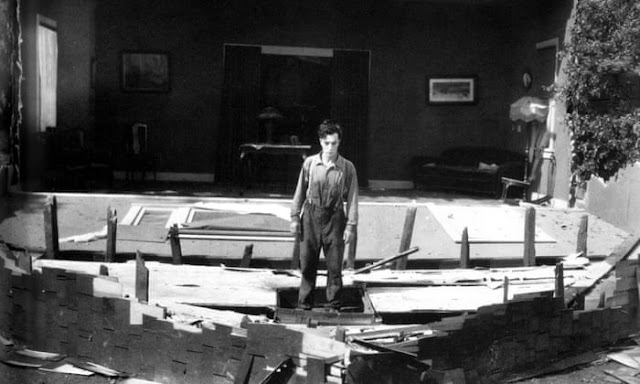
Buster Keaton & Charles Reisner’s “Steamboat Bill Jr.” Buster Keaton” “Steamboat Bill Jr.” tells the story of a college graduate named William Canfeild Jr. who reunited with his long lost father, a Mississippi Riverboat Captain. The theme of the film seems to be parental rejection. In the film, Bill Jr. is a let-down to his father, who sees him as a wimp, unable to stand up for himself and do the hard work needed to be an adult. He also disapproves of his invested interest in the daughter of his riverboat rival – who he sees a rich snob who is taking over his riverboat industry. Both father try to control their children, as Bill Sr.’s rival, JJ King tells his daughter, Kitty, “I’ll pick the young man for you – and it won’t be the son of a river tramp.” Bill Sr. similarly tells Bill Jr., “I’ll pick the young lady for you – and it won’t be a girl with a father like that.” Both parents are disappointed in their children’s choices and try to control them. Bill Sr. even takes Bill Jr. t...