Posts

Contemporary 2021 Selection: King Richard (2021)

Image
  Reinaldo Marcus Green's "King Richard" "King Richard" is a sports biopic about the father of two tennis champions, Venus and Serena Williams. Green's vision is that of a traditionally shot sports biopic. However, one important thing to note is that the typical framework of a sports biopic consists of a 'downfall' for the protagonists that ultimately challenge them to go the extra mile to make them great. However, the atheletes never take a tumble, and are ultimately ascended to the top with no skirts along the way, other than their destructive father. Even though his plan 'worked,' the protagonist, played brilliantly by Will Smith, is both the hero and villian of this story.  At times you cheer on his unyielding determination, other times you curse him for his meddeling. It is an interesting examination of the protagonist, as the viewpoint of the film seems to shift between how he is holding the girls back, and how he is ensuring their succ...

Blonde Venus (1932)

Image
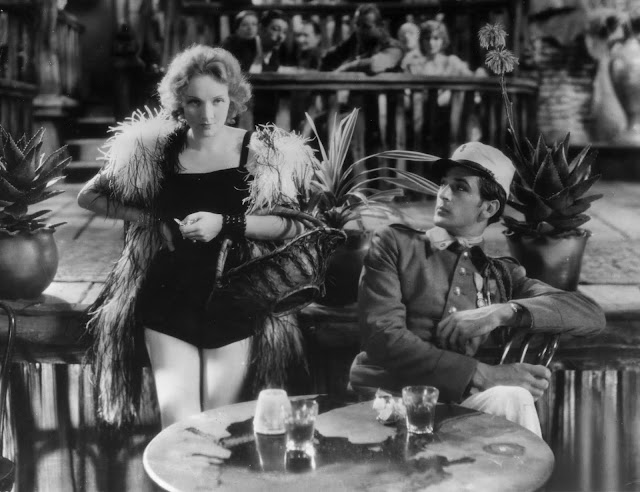
  Josef von Sternberg's "Blonde Venus" "Blonde Venus" was the fifth of seven collaborations between Josef von Sternberg and Marlene Dietrich. Sternberg had difficulties getting the film made, especially through the new Motion Picture Production Code. The script was originally written by Marlene Dietrich in collaboration with Sternberg. However, through the newfound censorship codes, their story was watered down to satisfy the sensors. After writer Jules Furthman completely reworked the script, Dietrich and Sternberg no longer held interest with the story, as it was completely transformed into something else. That being said, this attempt by the two appears as more of a confusing piece, with the characters not making logical decisions and story beats not hitting. 

Shanghai Express (1932)

Image
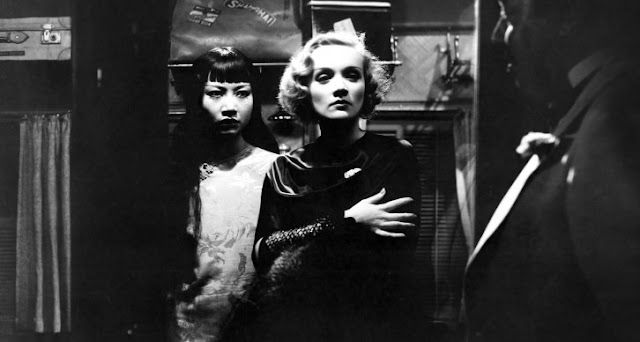
Josef von Sternberg's "Shanghai Express" Josef von Sternberg's "Shanghai Express" is about a group of international passengers making their way to Shanghai on the Shanghai Express that is eventually highjacked by radical Chinese revolutionaries. The plot of the film minutely matters to the artistic expression of light, shadow, reflection, surfaces, etc.  It becomes readily apparent at the beginning of the film that the primary artistic confection of the film is that of artifice. All of the characters are well-to-do passengers who are all unique. They all appear to be from varying countries. However, this variance is what displays the artifice of their personas. The rich woman who pretentiously denigrates the 'less respectable" members of the train is just an example of the feigned sense of ego and pretention that permeates the high class passengers. All of the characters are like warped personas of actual people, all adhering to strict beliefs and w...

Contemporary 2021 Selection: Belfast (2021)

Image
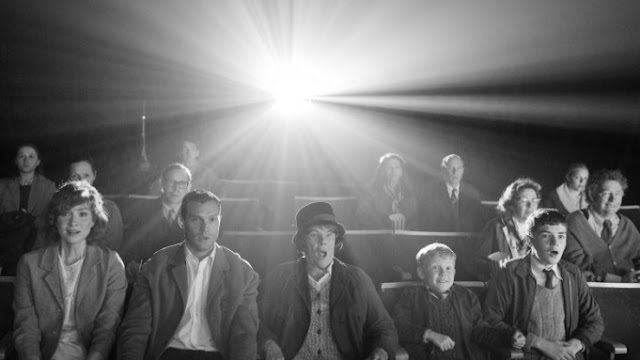
  Kenneth Branagh's "Belfast" Kenneth Branagh's most personal film in his oeuvre, "Belfast" seems to take inspiration from Alfonso Cuaron's 2018 masterpiece "Roma." Both films are about existential issues that plague a character during a period of civil unrest while they are coming of age in their home country. "Belfast" is a love letter to Branagh's home town, his childhood, and his family. The film is filled with brief respites of love and community in between moments of harsh conflict between neighborhoods. Branagh chooses black-and-white cinematography (much like Cuaron's Roma) to enhance the feeling of this picture being a memory.  In Branagh's onscreen childhood, he is constantly watching films, either on the big screen or on television. And it's hard not to have the rest of the film filtered through this perspective of film tropes. Whether it be the dramatic moment his mother uses a shield to protect them agains...

Morocco (1930)

Image
  Josef von Sternberg's "Morocco" After the success of "The Blue Angel," Josef von Sternberg took Marlene Dietrich to Hollywood to become Paramount's newest acting sensation. The first film that American audiences saw of Dietrich was 1930's "Morocco." The film would go on to have critical and commercial success and even saw von Sternberg getting nominated for Best Director and Dietrich for Best Actress. The film itself is known for having taboo sequences, including a scene in which Dietrich dresses as a man for a performances and even kisses another woman. The film would go on to make Dietrich the newest Hollywood 'it' girl. Morocco was also well known for its accurate depiction of the North African country. The Moroccan government even ran ads in the New York Times inviting American tourists to come and be seduced by the great country just as Gary Cooper did in the film.  Morocco tells the story of a world weary Chanteuse named Amy Jol...

Contemporary 2021 Selection: Passing (2021)

Image
  Rebecca Hall's "Passing" Rebecca Hall's directorial debut is a 2021 feature that has been adapted from Nella Larsen's 1929 novel of the same name. Hall employs very specific directional techniques to orchestrate a quiet, contemplative piece that stirs in its own complexity.  The black and white approach is interesting for the subject matter. We find that our characters, on the surface, are living in a black and white world. However, as the story progresses you find that things are not black and white at all. Things are rather grey. All of the characters have very complex emotionality, and can't quite pinpoint exactly what they want out of life, except that they just want to feel safe. Also, the black and white really presents everyone's skin tone with a varying degree of grey. This makes the petty difference between characters seem that much more absurd.  The lack of a score is interesting as well, as we are more in a meditative state of the comings and ...

The Blue Angel (1930)

Image
  Josef von Sternberg's "The Blue Angel" Adapted from Herman Mann's 1905 novel, "Professor Unrat (Professor Filth)," "The Blue Angel" is a 1930 masterpiece directly by Josef von Sternberg. Many of Mann's narratives were abandoned by Sternberg, as he kept only the story involving a high-class authoritarian bourgeois professor falling for a cabaret singer. During filming, Sternberg altered dialogue, added scenes, and modified characterizations that gave the script an entirely new dimension. He was formally requested by Berlin's UFA Studios and by the film's attached star, Emil Jennings - who Sternberg worked with previously on his 1928 film, "The Last Command." Sternberg also personally casted the role of the cabaret singer after extensive searching. He settled on Marlene Dietrich, who was a complete unknown at the time. After her performance in this film, her and Sternberg went to Hollywood together and created a run of 6 films...