Posts

Psycho (1960)

Image
  Alfred Hitchcock's "Psycho" A common piece of trivia you hear about Alfred Hitchcock's 1960 masterwork " Psycho " is that it is the very first film to ever feature a shot of a flushing toilet. Perhaps this is a mild piece of trivia, however I think it really connects me to a greater contextual understanding of the whole film. I'm sure seeing a flushing toilet on screen may have been a great 'shock' to a 1960's audience. I'm not entirely sure 'shock' is the right word, but given that the image may have been possibly taboo and perhaps anecdotal of unwanted imagining, its safe to say that Hitchcock and writer Joseph Stefano really wanted to hit their audience with an unsettling image. I think this idea holds the key to the whole film. The entirety of " Psycho " is really an unsettling shock to the audience's senses.  After Hitchcock made " Vertigo " in 1958, many felt that it was a bloated, overbudgeted misf...
Vertigo (1958)

Image
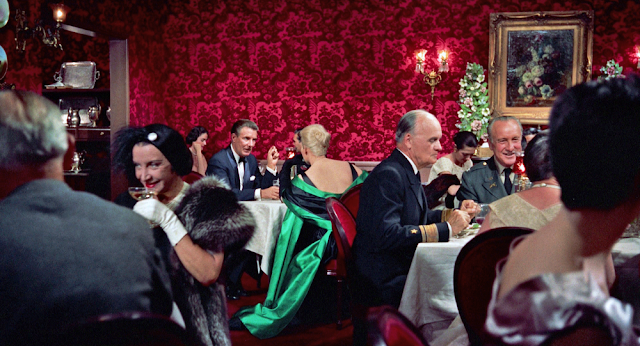
  Alfred Hitchcock's "Vertigo" Of all of Hitchcock's film I've seen, his 1958 masterwork " Vertigo " is by far is most perplexing. Walking away from the film, I feel a sense of confusion. Not necessarily because the film is rampant with plot holes, because really that's not the point of the film. Hitchcock films are full of plot holes and usually those turn out to be unnecessary to the integrity of the film. No, what confuses me about " Vertigo " is something far more deeper.  The film plays out like a noir: a retired detective gets dragged into a mystery involving a blonde femme fatale. However, " Vertigo ," with its bright saturated colors, looks nothing like a noir visually. Rather, its the visual inverse of one. However, Hitchcock uses the beauty of this incredible cinematography by Robert Burks to his own advantage. Typically in a noir, our protagonist cannot resist the urge to continue in his investigation, gravitating towar...

The Wrong Man (1956)

Image
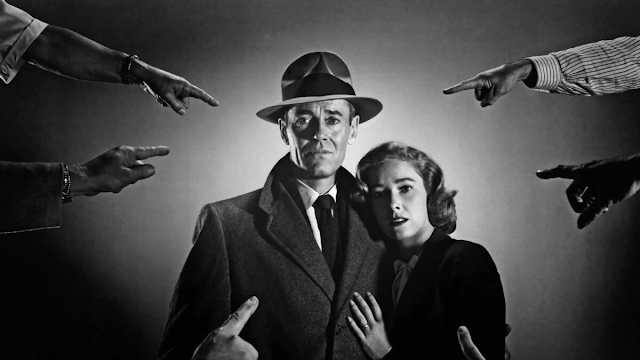
  Alfred Hitchcock's "The Wrong Man" When discussing the breadth of Hitchcock's oeuvre, his 1956 film " The Wrong Man " is rarely mentioned. This is rather unfortunate, as it is a film well worth observing and discussing. It seems like Hitchcock's attempt at a noir, at a time when the noir genre had reached its natural conclusion. Two years later, Orson Welles' " Touch of Evil " would put the exclamation mark on the genre's finality. Despite being a noir-influenced film, it still has all the landmarks of a Hitchcock suspense film. In fact, you might say " The Wrong Man " is Hitchcock boiled down to his very essence.  The film stars Henry Fonda as New York City musician named Christopher. He has a wife, Rose (played by Vera Miles), and two children. Christopher and his wife are down on their luck and needing money for Rose's dental concerns. One day, Christopher goes into a life insurance company to try and get a loan on hi...

The Man Who Knew Too Much (1956)

Image
  Alfred Hitchcock's "The Man Who Knew Too Much" Alfred Hitchcock's 1956 " The Man Who Knew Too Much " is almost a direct remake of his 1934 film of the same name. As stated in an interview with Francois Truffaut in 1967, Hitchcock stated that the first version "is the work of a talented amateur," while the second "was made by a professional." Personally, I couldn't agree more, as I have seen both and very much prefer the 1956 version.  The film tells the story of an American family vacationing in French Morocco who become involved in a political conspiracy. After their son gets abducted, they must further entrench themselves into the mire of an assassination attempt. These aspects of the film scream Hitchcock, as he often makes films dealing with an everyday man, woman, or group who must get involved in a political conspiracy unsuspectedly.  The film does not offer much in the realms of thematic depth. It is, however, an entertaining...

To Catch a Thief (1955)

Image
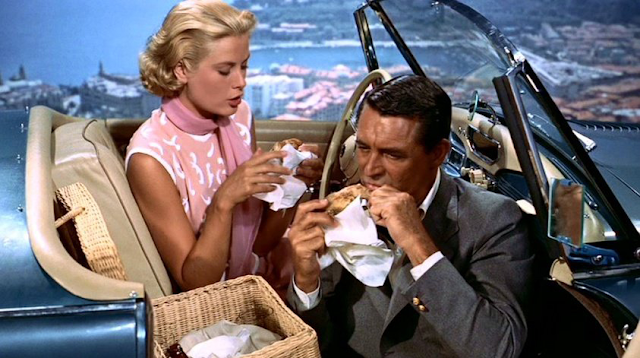
  Alfred Hitchcock's "To Catch a Thief" After dishing out " Rear Window ," the best film he had made in his career up until that point, Alfred Hitchcock decided to go on holiday. He did not take a break from making films, mind you. Rather, Hitchcock decided to make his 1955 film " To Catch a Thief " because he fancied himself a holiday in France. Watching the film makes it feel like you are watching Hitchcock on holiday. The film is full of lavish locations, beautiful views, and expensive aerial shots that were filmed from a G-AJOV helicopter.  The plot of the film, as well as its visual style, plays out like a James Bond movie, well before the character of Bond ever hit the screen in 1962 with " Dr. No ."  Cary Grant even behaves like James Bond. Grant, in 1953, had announced his retirement from acting. He felt that with screen presences like Marlon Brando and Montgomery Cliff, his type of acting was no longer required in the film industry. ...

Rear Window (1954)

Image
  Alfred Hitchcock's "Rear Window" Often called the 'Master of Suspense,' Alfred Hitchcock was a master at creating tension and anxiety within his audiences. By the 1950s, he had perfected his craft and reached the pinnacle of his success. His 1954 classic " Rear Window " is no exception. Going into this film, I knew it was a classic and considered one of his best. Even so, the film far surpassed my expectations.  It stars Jimmy Stewart as L.B. Jeffries, a professional photographer who is confined to a wheelchair in his apartment in Greenwich Village, Manhattan after suffering a broken leg. He is visited daily by Stella, his nurse, and Lisa, his socialite girlfriend, played by Grace Kelly. L.B. often finds himself emotionally distant from Lisa, as he feels they live two separate lives. He continues to push her away, despite her wanting to spend her life with him. During his days cooped up in his apartment, he has nothing to do but look out his rear windo...

Dial M for Murder (1954)

Image
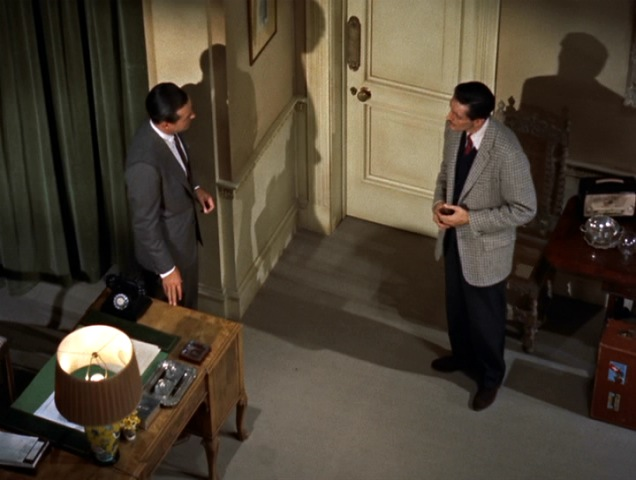
  Alfred Hitchcock's "Dial M for Murder" After watching Alfred Hitchcock's 1951 hit " Strangers on a Train ," I felt that despite Hitchcock's technical brilliance, he never really has a good story as a foundation. However, after watching " Dial M for Murder ," I found this only to be partially true. Sure, " Dial M for Murder " doesn't seem to have some deeper thematic resonance with 'the times' or hold some distinctly unique perspective about the nature of man. However, it's a fascinating film nonetheless.  The film follows the carefully meticulous plan of Ray Milland's Tony Wendice and his plan to murder his cheating wife, Margot, played by Grace Kelly. Most of the film's action takes place in a single apartment. However, unlike his 1948 experimental film, " Rope ," Hitchcock doesn't attempt any 'one-take' camera tricks. It is a simply shot and edited story as we watch Tony construct his ...