Posts

Gold Diggers of 1933 (1933)
Image
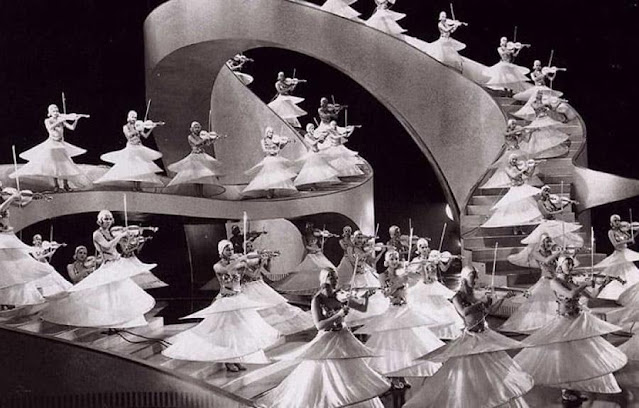
  Mervyn LeRoy's "Gold Diggers of 1933" Of all the early 1930s musicals that were made for Depression-era audiences, " Gold Diggers of 1933 " probably has to be the most esteemed. The film was a mega-success for Warner Brothers and made a profit of $1,602,503. The success was so massive, they made sequels in " Gold Diggers of 1935 " and " Gold Diggers of 1937 ."  I found the musical to be a worthy watch, particularly for a commercial venture. The plot of the film is rather uninteresting: four aspiring actresses and an aspiring songwriter attempt to construct a musical by manipulating the songwriter's rich brother to finance the show. The notion of 'constructing the musical' was a very often used story structure for early 1930s musicals, of which I've seen before in 1929's first sound musical, " The Broadway Melody ." However, what distinguishes " Gold Diggers of 1933 " from other like-minded musicals of...

I Am a Fugitive from a Chain Gang (1932)

Image
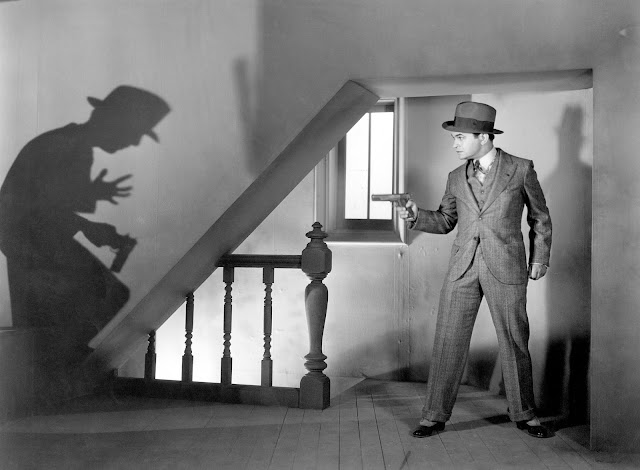
  Mervyn LeRoy's "I Am a Fugitive from a Chain Gang" In 1932, Warner Brothers wanted to adapt the autobiography of Robert E. Burns into a feature length film. Robert E. Burns' " I Am a Fugitive from a Georgia Chain Gang! " was about his wrongful conviction and sentencing of 10 years to a Georgia chain gang. The autobiography details the harsh treatment of the prisoners of this chain gang, imploring that their punishments far outweighed their crimes. Many directors with Warner Brothers were unwilling to make such a harsh and bleak film, especially the ill-timed realities of the Great Depression. Warner Brothers tasked director Mervyn LeRoy to direct the film, after just having a huge success with his ganger flick, " Little Caesar ."  There are many things I found interesting about " I Am a Fugitive from the Chain Gang ." When watching, I felt as though the film took many genres and shapes at various stages throughout its story. The first p...

Little Caesar (1931)

Image
  Mervyn LeRoy's "Little Caesar" Despite Josef von Sternberg initiating the 'gangster flick' with his 1928 silent film " Underworld ," it was Mervyn LeRoy's pre-code sound film " Little Caesar " that many consider the first fully-fledged of the genre. That is to say: it was the first to have all the aesthetics and story structure of the gangster flick formula. The film was based on the novel of the same name by William R. Burnett, which was in turn based on real-life Mafia boss Salvatore Maranzano.  The plot of " Little Caesar " is relatively simple. Small time criminal Rico Bandello moves to Chicago and joins in a gang to make some money. Through the operation of the gang, he eventually moves his way up. Eventually, he becomes a leader of his own gang and is eventually taken down in the end. Personally, I do not find any interest in the 1930s gangster film genre. I tend to find the genre to be lacking in any artistic appeal. Rath...

Bride of Frankenstein (1935)

Image
  James Whale's "Bride of Frankenstein" To me, James Whale's 1935 sequel to his original " Frankenstein " film, " Bride of Frankenstein " feels like a closing of the book on the highly successful Universal monster movies of the early 1930s. The monster movies that came after would only ever be B movie films that were made cheaply and did not receive as much commercial success. In watching it, I found it to be simply another cash-grab from Universal attempting to suck dry the successes of the previous film. That being said, I did notice some thematic interest in certain spots, like questions involving amorality in scientific innovation and humanity's cold indifference to things different than us. However, I still could not get over the mundanity of the plot. Even though the film is called " Bride of Frankenstein ," we do not actually get to see the Bride until there is only 10 minutes left in the film. The film was another massive succ...

The Invisible Man (1933)

Image
  James Whale's "The Invisible Man" I'm quite certain that there is a lot that could be said about the early 1930s Universal monster movie genre, including the 1933 James Whale contribution, " The Invisible Man ." However, this writer will not go that far. Personally, whilst watching this film, as well as the others of its genre, I find myself growing increasingly bored with each passing minute. That being said, I'm sure there are far more interested parties that could thematically dissect such a picture. After all, the 'horror' genre always points to certain anxieties felt in the time they were released. " The Invisible Man ," as well as other monster movies are no different, especially coming out during the Great Depression. However, I find these movies to be purely spectacle films, offering an escape from the grueling economic hardships faced during this time. 

Frankenstein (1931)

Image
  James Whale's "Frankenstein" After the success of Universal's " Dracula ," monster movies became a new commercial market for Hollywood studios. For the next half-decade, these monster movies were a great success. This was especially important due to the Depression-era audiences that were seeing these movies. Monster movies, gangster movies, and musicals were the most financially successful movies that Hollywood was producing, due in large part to the escapism they offered.  However, after watching James Whale's " Frankenstein ," I found myself being rather bored by it. Because the film is escapism, it was far more attractive to audiences attempting to watch a new spectacle. However, because spectaclism has evolved and grown over the last 90 years, the 'spectacle' elements of the film are a little more mundane and uninteresting. I did notice the parallels to the 1920 German film " The Golem ," especially many of the visual re...

That Obscure Object of Desire (1977)

Image
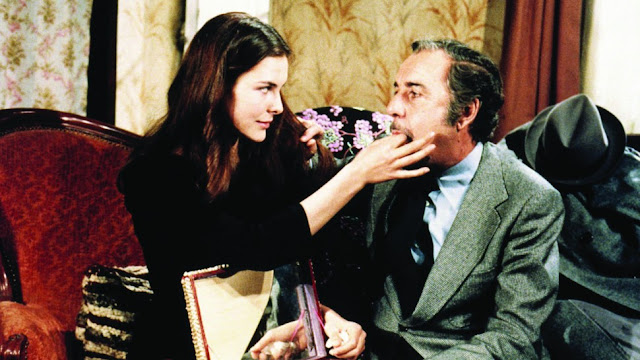
  Luis Bunuel's "That Obscure Object of Desire" Luis Bunuel's final film before his death, " That Obscure Object of Desire " does not feel like a thematic summation of his filmography. That regard would go to his prior film, " The Phantom of Liberty ." Rather, " That Obscure Object of Desire " feels more like a strange after-the-fact memo. It does not display the typical levels of surrealism that most Bunuel films are known for. However, it still manages to  Bunuel based his script on the 1898 Pierre Louys novel " The Woman and the Puppet ." His film tells the story of a wealthy Frenchman named Mathieu who becomes obsessed with a young, impoverished Spanish flamenco dancer named Conchita. As the two become intertwined in a romance, it becomes clear that Conchita will not let Mathieu have sexual relations with her. She continues to tease and sexually frustrate him, as he continues to give her money and other various things to win...