Posts

Throne of Blood (1957)
Image
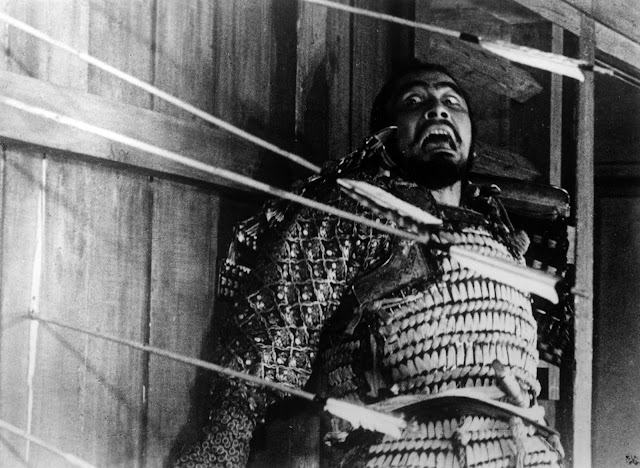
  Akira Kurosawa's "Throne of Blood" In 1957, Akira Kurosawa adapted William Shakespeare's " The Tragedy of Macbeth " to the film screen with " Throne of Blood ." As far as " Macbeth " adaptations are concerned, " Throne of Blood " is by far one of the more intriguing. The only element lost was the poetic prose of Shakespeare's dialogue. Despite this, Kurosawa still manages to visualize the rise and fall of the power hungry Macbath character, along with his manipulating wife.  Perhaps the most iconic scene and the scene which I consider my favorite is the climax in which the Macbeth character, Washizu, is shot by his own men with arrows. This comes after seeing the forest move in and surround him. The scene is brilliant for the same reason the entire film works well visually. Kurosawa is perhaps his most masterful in the way he visualizes his action, using space and the characters' physicality to speak volumes.  Despite ...

Seven Samurai (1954)

Image
  Akira Kurosawa's "Seven Samurai" Often looked at as the most remade, reworked, and referenced film in the history of cinema, Akira Kurosawa's " Seven Samurai " sets the standard for the large-scale action epic. It was the most expensive film ever made in Japan at the time and has since become the brightest beacon of post-war Japanese cinema.  The story takes place in feudal Japan in 1586 in a farmers' village. After overhearing that a group of bandits say they will return to raid the village after the harvest, members of the town locate an aging samurai to help protect them. After recruiting six more samurai, they work together along with the villagers to plan their defenses from the bandits, as well as training the villagers to fight. Despite many sacrifices and losses, they successfully defend the village and its people. What I love about " Seven Samurai " is also the reason why I love Kurosawa. Everything you need to know about the story i...

Ikiru

Image
  Akira Kurosawa's "Ikiru" I'm not sure what I expected when I sat down to watch Akira Kurosawa's 1952 film " Ikiru ." I knew the basic plot of the film - a bureaucrat tries to find meaning in his life when it is revealed that he is dying of stomach cancer. I imagined a film in which this man reconnects with his family, figures out why his life has value, and dies with his outlook changed and molded. However, the film is received was entirely different than the one I had imaged. Sure, the bureaucrat is able to attain some sense of peace about his death, but it is through a means that perhaps differs from my Western perspective. Because of my Western upbringing and perspective, I tend to think about things more individually. If I were to receive news upon my imminent death, I would do things that would replenish my own individual desires and expectations. I would, as I stated before, reconnect with my family and find some peace within myself. Sure, our bu...

Rashomon (1950)

Image
  Akira Kurosawa's "Rashomon" I have seen " Rashomon " a couple of times in my life. I can never get back the utter astonishment I felt by that first experience. This third time viewing the film will also never live up to the first experience. When you already know the structure, format, and plot of the film, it becomes harder to let the story unravel around you, leaving you merely examining the film as a whole experience rather than being pulled through the winding and shifting narrative. However, in my third viewing, I was able to pick up on larger contexts the film provides.  " Rashomon " and its story structure forever changed narrative stories. You may have seen a film or television series in which different characters recount the same events through their own unique lens. Each story abides by the same similar beats, but each individual's story is slightly different - offering a critique on human fallibility in regards to memory, truthfulness,...

Stray Dog (1949)

Image
  Akira Kurosawa's "Stray Dog" What struck me most when watching Akira Kurosawa's 1949 noir film " Stray Dog " was how much Kurosawa elevated his visual storytelling. There is still something to chew on in regards to the story, particularly the philosophy of the film's protagonist. However, what " Stray Dog " does best is engage the viewer visually.  The story centers on a green homicide detective, Murakami, whose had his gun stolen. In searching for the lost gun, he is assigned to team up with veteran investigator, Sato. Together, they form an unlikely bond while both sharing different generational perspectives. Sato believes that to be a cop, you must see the people you are chasing as 'bad' people while Murakami believes that they're just like you or me, only with their backs against the wall. After Murakami's stolen gun was used to rob and murder a woman, the two detectives work their way to tracking him down. Although the fi...

Drunken Angel (1948)

Image
  Akira Kurosawa's "Drunken Angel" In beginning my new venture into the work of Akira Kurosawa, my first film from his select filmography is perhaps his first major work. The film is considered by many to be a 'noir,' which would not be a consistent style in Kurosawa's work. However, " Drunken Angel " does offer an insightful ignition point into the work of a director and into the psyche of post-war Japan. " Drunken Angel " tells the story of an alcoholic doctor who becomes invested in a yakuza member after a devastating diagnosis. Despite coming to the doctor for a gunshot wound, the doctor uncovers a spot on the lung of the yakuza member, Matsunaga. The doctor, Sanada, wishes to treat Matsunaga, despite Matsunaga's stubbornness. In order to get better, Matsunaga must give up his drinking and smoking. This is turn means he must also give up the yakuza profession he's made for himself and the dangerous and degrading lifestyle. Throu...

The Baker's Wife (1938)

Image
  Marcel Pagnol's "The Baker's Wife" " The Baker's Wife " marks my last venture into the work of scriptwriter and director Marcel Pagnol. There is a lot that can be said about this famous Frenchman. His writing allows you to spend immense time with everyday people. The dialogue seeps with domestic woes and common vernacular. Pagnol was a true poetic realist. I can undoubtedly see the merits in his work and understand its important place amongst 1930s French cinema. That being said, I tend to find the works too long for their respective subject matters. I always tend to start really becoming invested in the story and the lives of the characters in the very beginning. However, once I reach three quarters of the way through the film, I find myself fatigued. Obviously, I can see the merits of what I'm watching. However, I might not be in the right place in my life at the moment to find an immediate connection to the work.  " The Baker's Wife ...